Blog

Explore our latest thoughts, ideas, and insights

TIDY 6.11 gives customers more control over their property details, expands how you can reach the AI agent, and resolves a set of bugs across scheduling, property selection, and automation.

New Features & Improvements

  • Edit Property Details: You can now update bedrooms, bathrooms, square footage, year built, and WiFi details directly from your property settings — no need to contact support to make corrections.
  • Phone & SMS Access to AI Agent: You can now call or text the TIDY AI agent via a dedicated phone number. It works just like the in-app chat — ask questions, manage properties, or get help with your account.
  • Automatic Account Manager Assignment: Every new customer is now automatically assigned a dedicated account manager (concierge) at signup, so you have a consistent point of contact from day one.
  • Payment Method on AI Shared Links: Shared links generated by the AI agent now support adding a payment method, making it easier for your team or guests to complete bookings end-to-end.

Bug Fixes

  • Fixed an issue where the property selector (tidy-select) wasn't working for some users, preventing them from switching between properties.
  • Fixed an issue where job requests were not appearing when viewing the Monthly Schedule, causing some upcoming jobs to appear missing.
  • Fixed the Automations page timing out for customers with many automations — the page now loads reliably regardless of how many workflows you have configured.
  • Fixed an issue where creating a workflow from a template returned no data, which could cause the new workflow to not appear immediately after creation.

If you manage Airbnb or VRBO properties, you already know the grind: check the calendar, message the cleaner, confirm the turnover, update the listing, repeat. What if your AI coding agent could handle all of that?

With TIDY's agent skills, you can install a single command and let Claude Code (or Codex CLI, Cursor, or any compatible agent) manage your vacation rental operations directly. Schedule turnovers, track maintenance, and coordinate pros — all through natural language.

This tutorial walks you through setting it up from scratch.

What You Need

  • A TIDY account — sign up free
  • Claude Code, Codex CLI, Cursor, or another compatible AI agent
  • 5 minutes

Step 1: Get Your API Token

Sign up or log in to TIDY, then generate an API token. You can do this via the API:

curl -X POST https://api.tidy.com/v1/customer/login \
  -H "Content-Type: application/json" \
  -d '{"email": "you@example.com", "password": "your-password"}'

Save the token:

export TIDY_API_TOKEN=your-token-here

Step 2: Install the Skill

For vacation rental management, install the tidy-vacation-rental skill:

npx skills add TIDYAPP/tidy-agent-skills --skill tidy-vacation-rental

That's it. Your agent now understands TIDY's vacation rental workflows.

Step 3: Add the MCP Server (Optional but Recommended)

Skills teach your agent how to use TIDY. The MCP server gives it the actual tools to call. For the best experience, add both:

claude mcp add tidy -- npx @tidyapp/mcp-server

Step 4: Try It

Now ask your agent something like:

"I have a guest checking out of 123 Beach Rd on Saturday at 11am. A new guest arrives at 3pm. Schedule the turnover clean."

Your agent will use TIDY to create the reservation, schedule the cleaning between checkout and check-in, and confirm the booking. You can follow up with:

"What cleanings are scheduled across all my properties this week?"
"Cancel the turnover clean for 456 Oak Ave, the guest extended their stay."

Real Workflow Example

Here's what a typical session looks like. You open Claude Code and type:

You: Set up a new Airbnb listing at 789 Pine St,
     gate code is #4521, park in the driveway.

Agent: ✓ Address created at 789 Pine St.
       Gate code and parking instructions saved.

You: I have a guest checking out Sunday at 10am,
     new guest arrives at 4pm. Schedule the turnover.

Agent: ✓ Turnover cleaning scheduled.
       Sunday 10:30 AM - 2:00 PM at 789 Pine St.
       Pro will receive gate code automatically.

No app switching. No manual coordination. Your agent handles the logistics while you handle the strategy.

Not Just Vacation Rentals

If you manage properties that don't have guest turnover cycles — like your home or office — install the tidy-cleaning-maintenance skill instead:

npx skills add TIDYAPP/tidy-agent-skills --skill tidy-cleaning-maintenance

This skill focuses on recurring cleanings, maintenance issue tracking, and pro management.

Learn More

Changelog v6.10.5|

Set Up TIDY's MCP Server in 5 Minutes

TIDY's MCP server lets any MCP-compatible AI agent manage your properties. Claude Desktop, Claude Code, Cursor, Codex CLI, VS Code with Copilot — if it supports MCP, it can now schedule cleanings, report maintenance, and coordinate turnovers through TIDY.

Setup takes under 5 minutes. Here's how.

What is MCP?

Model Context Protocol (MCP) is the open standard for connecting AI agents to external tools and services. Instead of hard-coding API calls, your agent discovers available tools through MCP's protocol and calls them as needed. This means your agent doesn't need to know TIDY's API schema in advance — it learns what's available automatically.

Step 1: Get Your API Token

You need a TIDY account and API token. If you don't have one:

  1. Create a free TIDY account
  2. Get your token via the login endpoint:
    curl -X POST https://api.tidy.com/v1/customer/login \
      -H "Content-Type: application/json" \
      -d '{"email": "you@example.com", "password": "your-password"}'
  3. Save the returned token for the next step.

Step 2: Add the MCP Server

Choose your platform:

Claude Code

claude mcp add tidy -- npx @tidyapp/mcp-server

Set your token as an environment variable: export TIDY_API_TOKEN=your-token

Claude Desktop

Go to Settings > Developer > Edit Config and add:

{
  "mcpServers": {
    "tidy": {
      "command": "npx",
      "args": ["@tidyapp/mcp-server"],
      "env": {
        "TIDY_API_TOKEN": "your-token"
      }
    }
  }
}

Cursor

Go to Settings > MCP and add the same JSON configuration as Claude Desktop.

VS Code (Copilot)

Create .vscode/mcp.json in your project:

{
  "servers": {
    "tidy": {
      "command": "npx",
      "args": ["@tidyapp/mcp-server"],
      "env": {
        "TIDY_API_TOKEN": "your-token"
      }
    }
  }
}

Codex CLI

codex mcp add tidy -- npx @tidyapp/mcp-server

Step 3: Test It

Open your agent and try:

"Use TIDY to list my addresses"

If you don't have any addresses yet:

"Use TIDY to add a new property at 123 Main St, Miami FL 33101. Gate code is #1234, park in the driveway."

Then try something more practical:

"Schedule a 2-hour cleaning next Tuesday afternoon at 123 Main St"

What Your Agent Can Do

Once connected, your agent has access to 5 MCP tools:

  • message_tidy — The primary interface. Send any natural language request.
  • get_status — Check status of a request or job.
  • list_addresses — See all your properties.
  • list_bookings — View upcoming and past cleanings.
  • list_issues — Track maintenance issues.

The message_tidy tool is the most powerful — it accepts natural language and TIDY figures out what to do. Your agent can say "the bathroom faucet is leaking" and TIDY will create a maintenance issue, categorize it, and optionally assign it for resolution.

Bonus: Add Agent Skills Too

MCP gives your agent the tools. Skills give it the knowledge. For the best experience, install a TIDY agent skill alongside the MCP server:

npx skills add TIDYAPP/tidy-agent-skills

This teaches your agent TIDY-specific workflows, like how to handle a guest turnover or set up recurring maintenance.

Learn More

Changelog v6.10.5|

TIDY CLI: Property Management from Your Terminal

If you live in the terminal, you shouldn't have to leave it to manage your properties. The TIDY CLI brings property management to the command line — schedule cleanings, report maintenance, check bookings, and manage your portfolio without opening a browser.

Install in Seconds

npm install -g @tidyapp/cli

Or run without installing:

npx @tidyapp/cli message "Schedule a cleaning next Tuesday"

What It Does

The TIDY CLI wraps our REST API into a developer-friendly interface. Everything you can do through the API, you can do from your terminal:

  • Natural language requests tidy message "Book a cleaning next week"
  • Booking management — List, create, and cancel cleanings
  • Maintenance tracking — Report issues, track resolution
  • Property management — Manage addresses, access notes, parking info
  • Guest reservations — Track check-ins and check-outs
  • JSON output — Pipe results to jq, scripts, or other tools

Quick Tour

Authenticate

$ tidy login
Email: you@example.com
Password: ********
✓ Logged in successfully. Token saved.

Schedule a cleaning with natural language

$ tidy message "Schedule a 2-hour cleaning next Tuesday afternoon at my office"
✓ Booking created: #78901
  Date: Tuesday March 25, 1:00 PM - 5:00 PM
  Address: 456 Oak Ave

Check what's scheduled

$ tidy bookings list --upcoming
ID      Date         Address          Status
78901   Mar 25       456 Oak Ave      Confirmed
78902   Mar 27       123 Main St      Pending

Report a maintenance issue

$ tidy issues create --address 1001 --urgent "Kitchen faucet leaking"
✓ Issue created: #4567
  Priority: Urgent
  Status: Open

Get JSON output for scripting

$ tidy bookings list --upcoming --json | jq '.[].address'
"456 Oak Ave"
"123 Main St"

Why a CLI?

We built the TIDY CLI for developers who want to:

  • Script property management — Cron jobs, CI/CD pipelines, or custom automation scripts
  • Quick status checks — Faster than logging into a web app
  • Combine with other tools — Pipe JSON output to jq, grep, or your own scripts
  • Test API integrations — Verify requests before building them into your app

CLI vs MCP vs Skills

The CLI is for humans working in the terminal. If you want your AI agent to use TIDY:

  • MCP Server — Direct tool access for Claude, Cursor, Codex, and other MCP agents
  • Agent Skills — Pre-built workflow knowledge for the skills.sh ecosystem

All three use the same underlying REST API, so you can mix and match based on your workflow.

Get Started

npm install -g @tidyapp/cli && tidy login

Full command reference: CLI Reference Docs

See all developer tools: Developer Hub

Most software today is designed for humans. A person opens an app, navigates menus, fills out forms, clicks buttons. The entire interface assumes a human is on the other end.

We believe that assumption is about to change—fundamentally and permanently. Over the next several years, the majority of interactions with software like TIDY will not come from humans clicking through a UI. They will come from AI agents acting on behalf of humans—personal assistants, property management agents, home automation systems, and general-purpose agents that handle the logistics of daily life.

We are building accordingly. Today we are launching TIDY's new MCP server and general-purpose API, designed from the ground up for the agentic era.

What We Are Launching

Two things, both aimed at making TIDY the easiest way for any AI agent to handle cleaning and maintenance.

A new MCP server. Model Context Protocol is the open standard for connecting AI agents to external tools and services. Any MCP-compatible agent—Claude, and a growing number of others—can now connect to TIDY's MCP server and make cleaning and maintenance requests directly. The agent does not need to know our API schema in advance. It discovers TIDY's capabilities through MCP's tool discovery protocol, understands what actions are available, and calls them as needed.

A new general-purpose API. We have updated and expanded our REST API with endpoints designed specifically for agent consumption. These endpoints accept natural language alongside structured data, so an agent can describe a problem in plain English—"the kitchen faucet is dripping and there's water on the floor"—and TIDY's AI interprets the request, routes it to the right service category, and returns a structured response the agent can act on.

The core idea is simple: an agent can call into TIDY with almost any cleaning or maintenance request, and we can respond back—with actions, status updates, options, or clarifying questions. TIDY becomes a service that agents can use the same way a human would use a property manager: describe what you need, and we handle it.

Why Agents Change Everything

Consider how property maintenance works today. A homeowner notices a problem. They open an app or make a phone call. They describe the issue, wait for a response, compare options, confirm a time, and follow up to make sure the work was done. Each step requires the human's attention.

Now consider what happens when an AI agent handles this. The homeowner tells their assistant—in conversation, by text, or through any interface—"the kitchen faucet is dripping." The agent takes it from there. It files the request with TIDY. TIDY's system classifies the issue, checks the property's digital twin for relevant context (what kind of faucet, when it was last serviced, which plumber has the best track record for this type of repair), proposes options, and sends them back to the agent. The agent confirms on behalf of the owner, or asks a clarifying question if needed. The repair is scheduled, the pro is dispatched, and the agent follows up when the job is complete.

The owner's total involvement: one sentence.

Or take a more proactive scenario. A general-purpose home management agent notices it's been three months since the last deep clean. Based on the owner's preferences, it initiates a request through TIDY—no prompt from the owner at all. TIDY schedules the cleaning, the pro confirms, the job gets done. The owner gets a notification that their home was cleaned. That is it.

The interface shifts from UI to conversation. From human-driven to agent-driven. TIDY needs to be on the other end of that conversation, and with our new MCP server and API, we are.

How It Works

MCP Server

MCP is an open protocol that lets AI agents discover and use external tools. When an agent connects to TIDY's MCP server, it receives a list of available tools—things like requesting a cleaning, scheduling maintenance, checking job status, or getting a quote. The agent can then call these tools as part of a conversation with the user.

From the agent's perspective, TIDY is just another tool in its toolkit. The agent does not need custom integration code or knowledge of our internal data model. It discovers what TIDY can do, and uses those capabilities as needed.

General-Purpose API

Our updated REST API is designed for flexibility. Traditional APIs require callers to know the exact endpoint, parameters, and data format. That works for human developers building integrations, but agents operate differently. They reason about problems in natural language and need interfaces that can meet them where they are.

TIDY's new API endpoints accept both structured requests and natural language descriptions. An agent can send a fully structured request if it has the data, or a plain English description if it does not. TIDY's AI layer handles the interpretation either way—classifying the request, extracting relevant details, and routing it to the right workflow.

Responses are structured and machine-readable, designed for agents to parse and act on without ambiguity. Status codes, action options, estimated timelines, and next steps are all returned in a format that agents can reason about programmatically.

Webhooks for Agent Awareness

Agents need to stay informed. Our webhook system notifies agents when events happen—a job is completed, an issue is detected, a pro confirms or reschedules. This allows agents to proactively update their users or take follow-up actions without polling.

Full documentation is available in our developer docs.

Why We Are Building for Agents First

This is not a side project or a nice-to-have integration. We believe agents will be the primary way people interact with services like TIDY within the next few years.

Think about the trajectory. Today, most people manage their homes reactively. Something breaks, they deal with it. Cleaning gets scheduled when someone remembers to schedule it. Maintenance gets done when it becomes urgent. The friction of coordinating these things means they are often deferred, forgotten, or handled poorly.

Agents eliminate that friction entirely. When your AI assistant can handle a maintenance request in the time it takes you to mention it, the entire model shifts from reactive to proactive. Homes get maintained better because the cost of coordinating maintenance drops to near zero.

We have spent 12 years building the infrastructure to coordinate cleaning and maintenance at scale—digital twins of properties, AI models trained on data from over 100,000 homes, a vetted network of service providers, predictive scheduling, quality verification. All of that infrastructure now sits behind an interface that any agent can use.

The hard part was never the interface. The hard part was building the operational backbone that makes it possible to say "fix my faucet" and have it actually happen, reliably, at scale. That backbone exists. Now we are opening it up to every agent that wants to use it.

What This Means

For property owners and homeowners: Your AI assistant—whatever form it takes—can now manage your cleaning and maintenance through TIDY. Describe a problem in conversation and it gets handled. Set preferences once and let your agent manage the rest proactively.

For developers building agents: If your agent needs to handle anything related to cleaning or maintenance, TIDY is the backend. Connect via MCP for the simplest integration, or use our REST API for more control. Either way, you get access to TIDY's full operational infrastructure—scheduling, pro dispatch, quality verification, digital twins—without building any of it yourself.

For the industry: The coordination layer is becoming invisible. The future is not humans managing software that manages properties. It is agents managing properties through services like TIDY, with humans involved only when they want to be. We are making sure TIDY is ready for that future.

Start Building with TIDY

Connect your agent to TIDY's MCP server or explore our API to add cleaning and maintenance capabilities to any application.

Property management is a $137 billion industry in the United States. It is also, by almost any measure, broken.

If you own a rental property, you have two options. You can manage it yourself, which means fielding tenant calls at midnight, coordinating cleaners who may or may not show up, chasing down maintenance contractors, and spending hours each month on scheduling, communication, and problem-solving. Or you can hire a property manager, who will charge you 20 to 30 percent of your rental revenue to do those same things, often with inconsistent quality and limited transparency into what you are actually paying for.

Most property owners choose option one. Only about 20 percent of rental properties in the United States use professional property management. The number one reason cited by those who manage their own properties is cost. At 20 to 30 percent, the math simply does not work for most owners, especially those with one to four properties.

This is not a new problem. Property management fees have barely changed in decades. The industry has resisted disruption because the core work—coordinating the physical operations of a property—is genuinely difficult. It is local, high-variance, and dependent on real people showing up at real places at specific times.

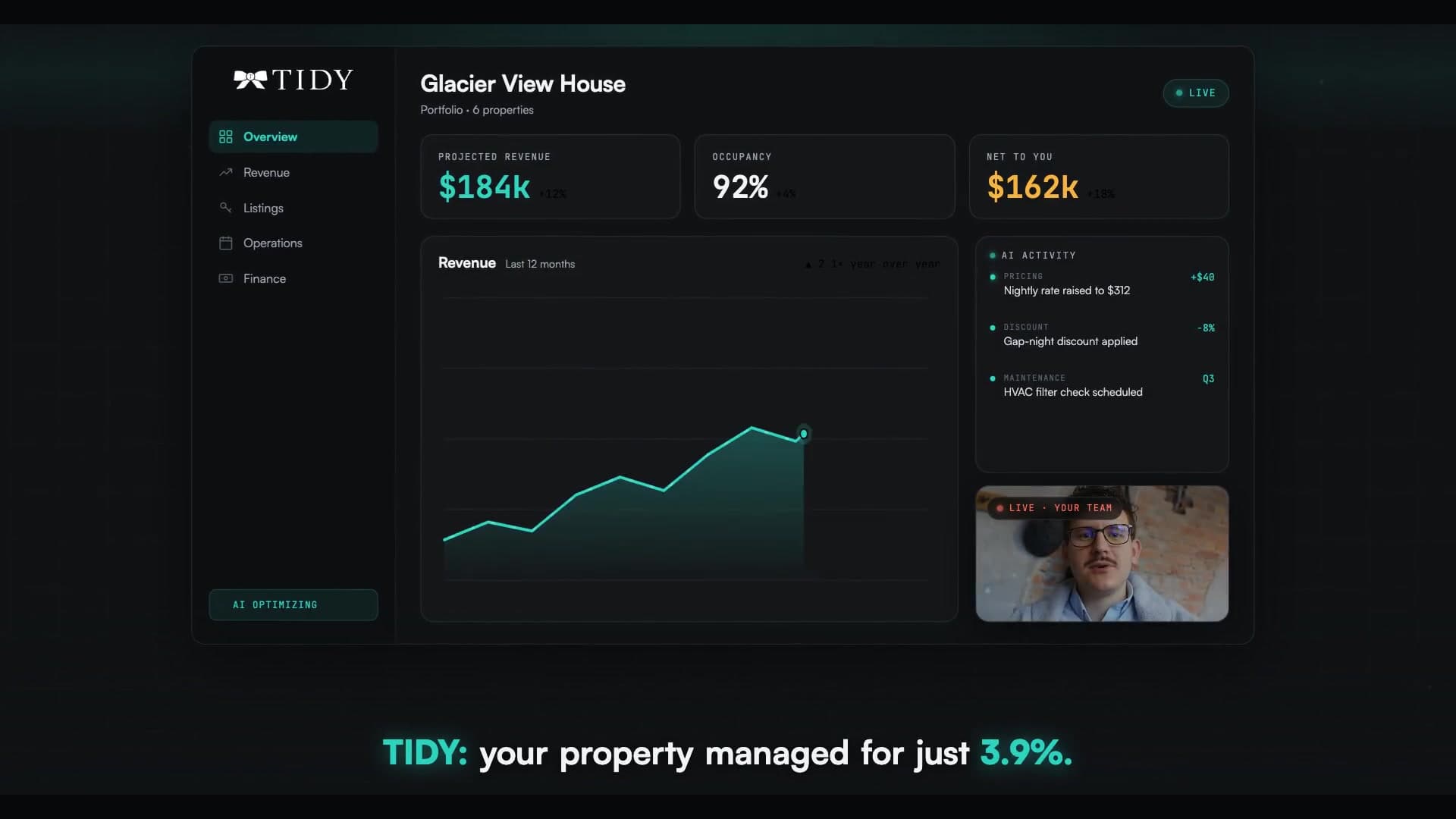
Today we are announcing something we believe changes this equation permanently. TIDY is launching the world's first end-to-end AI property manager, delivering full property management—everything a traditional PM does—for 3.9 percent of revenue. That is 85 percent less than a traditional property manager.

This is not a chatbot. It is not a feature inside someone else's software. It is a complete property management platform—from cleaning and maintenance coordination to revenue management, guest communication, leasing, and emergency response—powered by AI and backed by human experts for edge cases.

To understand why this matters, and why we believe no one else can do this right now, you need to understand what actually goes wrong in property management and why even the biggest companies that have tried to solve it have failed.

What Happens When You Skip the Hard Part

Consider the largest publicly traded property manager in the United States. They went public via SPAC in late 2021 at approximately $10 per share. The stock peaked near $205, split-adjusted. At its height, the company was valued at roughly $4.5 billion and managed around 44,000 properties.

Then it collapsed. The stock fell 97 percent. Revenue dropped from $1.12 billion to approximately $910 million in a single year. The company accumulated more than $850 million in cumulative losses. They lost 4,000 homes—9 percent of their portfolio—in a single year as owners left over poor communication and disappointing returns. Ultimately, the company was acquired in a distressed sale for approximately $130 million and delisted from the stock exchange.

A $4.5 billion company reduced to a $130 million distressed acquisition. What happened?

The answer is deceptively simple. They solved the easy parts of property management and failed at the hard part.

The easy parts of property management are the things that can be centralized and run from anywhere. Marketing. Revenue management. Dynamic pricing. Guest messaging. Listing optimization. These are inherently digital, text-based tasks. You can run them from a single office for thousands of properties. Many companies have automated them successfully.

The hard part is the physical operations. Scheduling cleaners across thousands of properties in hundreds of markets. Handling no-shows. When a cleaner does not show up two hours before a guest arrives, someone has to solve that problem immediately. Verifying quality. Managing emergency maintenance at 2 AM. Coordinating plumbers, electricians, HVAC technicians, handymen, and dozens of other service providers, each with their own schedules, capabilities, and reliability track records.

This is what brought the company down. Their centralized operations—marketing, revenue management, guest communication—worked fine. But the local operations—the boots-on-the-ground coordination of cleaning and maintenance across hundreds of markets—could not be done cost-effectively with the tools and approaches they had. Every property is different. Every market is different. The variance is enormous, and the cost of failure is immediate and visible. A dirty property means a bad review. A bad review means fewer bookings. Fewer bookings means the owner leaves.

They tried to solve this by hiring more people. More local teams, more coordinators, more managers. The headcount grew, the margins shrank, and the quality still was not consistent enough to retain owners. The fundamental problem was that human coordination of local physical operations does not scale linearly. It scales with friction, exceptions, and compounding complexity.

The Half-Service Model: Skip the Hard Part Entirely

Others in the industry took the opposite approach. They looked at property management, identified the easy half—digital marketing, revenue management, guest communication—and built businesses around just that. They charge 10 to 15 percent, which is less than a traditional PM, and some manage tens of thousands of properties.

But if you use one of these services, you still need to find your own cleaners. You still need to coordinate your own maintenance. You still need to handle the 2 AM emergency yourself. You still need to verify that the work was done correctly. You still need a backup plan when your cleaner cancels two hours before check-in.

These models solve half the problem and leave the hardest half to the owner. That is why they can charge less than a traditional PM. They do less. And critically, they do not fundamentally change the economics for the property owner. You are still paying for coordination—just less of it—and doing the rest yourself.

This is the fundamental tension in the industry. Full-service property managers charge 20 to 30 percent because the physical coordination is genuinely expensive and difficult. Half-service companies charge 10 to 15 percent because they skip it. Neither model serves the property owner well. One is too expensive. The other is incomplete. Neither fundamentally changes the underlying cost structure.

Why We Spent 12 Years on Cleaning and Maintenance

TIDY was founded over 12 years ago. For the vast majority of that time, we focused on one thing: building the technology, AI, and operational infrastructure to coordinate cleaning and maintenance at scale.

This was not an accident. We understood from the beginning that the physical operations layer was the bottleneck for the entire property management industry. It was the part that could not be centralized. It was the part that required local knowledge, real-time decision-making, and the ability to handle thousands of edge cases. It was the part that everyone else either failed at or avoided.

Here is what 12 years of focused work on this problem produced:

  • Digital twins of every property. Not a listing description. A structured digital model of the property including rooms, appliances, surfaces, access procedures, and complete maintenance history. When a tenant reports a problem, the AI already knows what is in the property, when it was last serviced, and what is likely wrong.
  • AI models trained on data from over 100,000 properties. These models predict issues before they happen, optimize scheduling decisions, and make judgment calls that previously required an experienced human coordinator. When a cleaner cancels, the system does not just send an alert. It has already identified the best backup providers based on proximity, availability, quality scores, and cost, and it dispatches a replacement automatically.
  • A network of vetted, performance-tracked service providers. Not a directory. A managed network where every provider has a quality score based on hundreds of data points: on-time rates, customer satisfaction, photo verification of completed work, consistency over time. The AI routes work to the best-performing providers and reduces allocation to underperformers. This is a meritocratic system that rewards quality.
  • 98 percent no-show prediction accuracy. The system knows which jobs are at risk of a no-show before they happen and proactively arranges contingencies. This is the kind of capability you cannot build in a year or two. It requires years of operational data across thousands of providers and tens of thousands of jobs.
  • 96 percent or higher on-time reliability. Industry average for individual contractors is approximately 70 percent. Professional firms achieve about 92 percent. We are at 96 percent and climbing, because the AI continuously optimizes provider selection and scheduling.
  • Human experts for edge cases. AI handles the vast majority of routine coordination decisions. The genuinely complex situations that require judgment, empathy, or creative problem-solving are handled by dedicated human account managers. This is not a fully automated system with no human safety net. It is an AI-first system with human expertise where it matters most.

This is the foundation. The hard part. The part that brought down the largest publicly traded PM. The part that half-service companies skip. We spent 12 years building it because we knew that whoever solved local physical operations at scale would be positioned to deliver full property management at a fundamentally different cost structure.

Adding the Easy Parts on Top of the Hard Part

Once you have solved the coordination of physical operations at scale, adding the traditionally easy parts of property management is architecturally straightforward.

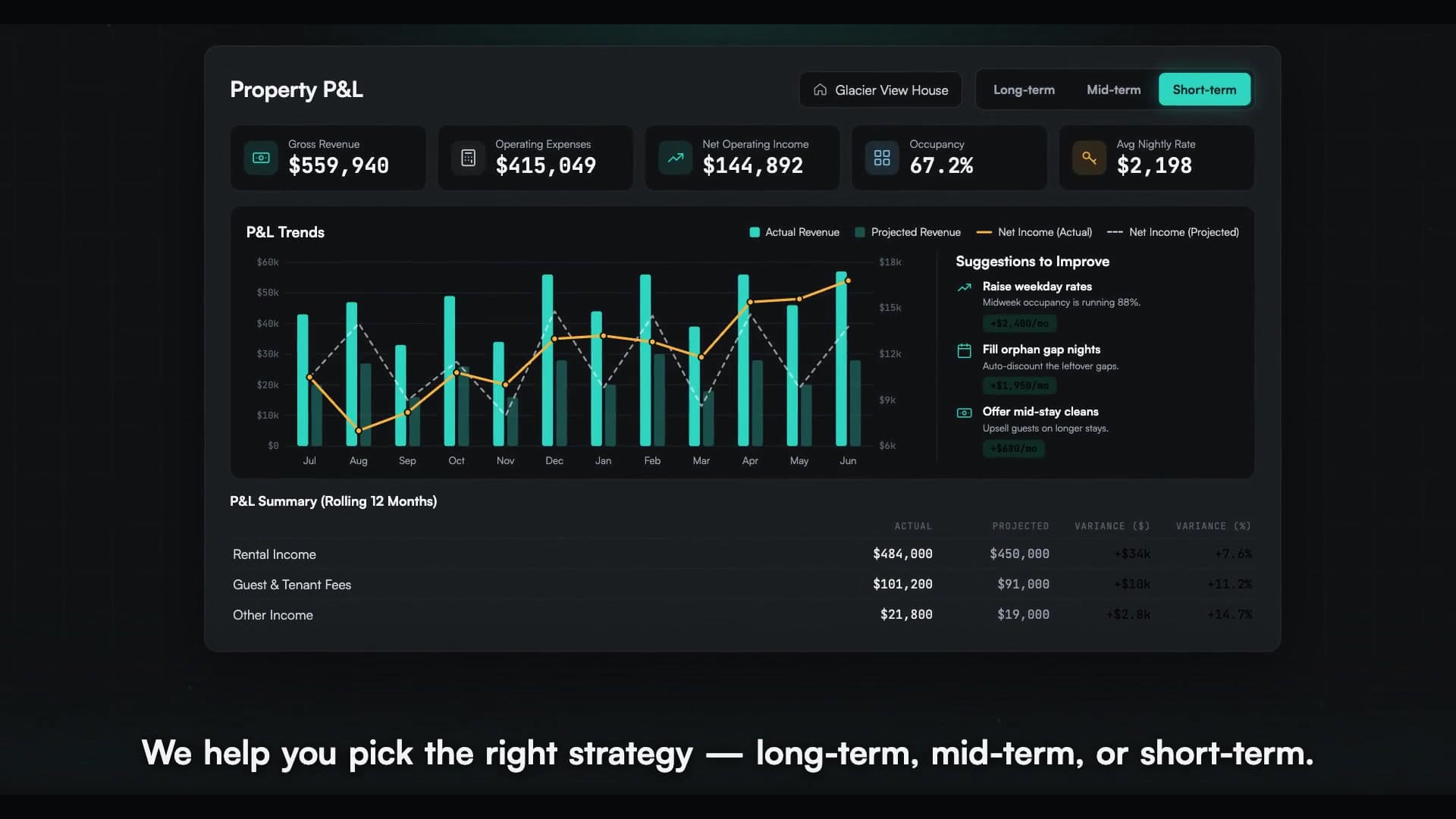
Revenue management and dynamic pricing are API-driven analytics tasks. Guest communication is a text-based workflow perfectly suited to AI. Leasing and tenant screening are structured decision processes. Sales calls and owner onboarding are conversational AI applications. PMS operations—calendar syncing, booking management, financial reporting—are software integration problems.

None of these are trivial. They all require careful engineering. But they are fundamentally different in nature from the local physical operations problem. They can be centralized. They can be fully automated. They do not require local knowledge or real-time physical coordination.

We built these capabilities through a 12-agent AI architecture. Twelve specialized AI agents, each responsible for a specific domain of property management operations, working together to deliver the full scope of what a traditional property manager does. Cleaning coordination. Maintenance management. Revenue optimization. Guest communication. Owner reporting. Emergency response. Leasing. Financial management. Quality assurance. Vendor management. Sales. Account management.

Each agent is purpose-built for its domain, trained on our 12 years of operational data, and integrated with the others so that decisions in one domain inform decisions in all others. When a maintenance issue is detected, the maintenance agent coordinates the repair, the guest communication agent notifies the affected guest, the revenue agent adjusts pricing if the property will be temporarily unavailable, and the owner reporting agent updates the owner—all automatically, all in real time.

This is what end-to-end means. Not one AI feature bolted onto a traditional workflow. Not a chatbot that answers tenant questions. A complete, integrated system that handles every aspect of property management from physical operations to digital operations to financial operations.

Why 3.9 Percent Is Possible

Traditional property managers charge 20 to 30 percent because human coordination is expensive. A human property manager can effectively manage approximately 50 properties. They need an office, a phone system, support staff, and local teams in every market they serve. The coordination labor alone costs approximately $128 to $160 per property per month.

AI changes this math entirely. Our AI-driven coordination costs approximately $37 per property per month. A single human account manager, handling only the edge cases that AI escalates, can oversee approximately 150 to 200 properties. The marginal cost of adding the next property is near zero.

This is not a loss leader. This is not subsidized by venture capital. This is the actual cost structure when AI handles the vast majority of coordination decisions. The 3.9 percent fee covers our costs and generates healthy margins at scale because the underlying economics are fundamentally different from a human-labor-intensive model.

At 3.9%, on a property generating $40,000/year in rental revenue, the management fee is $1,560/year. A traditional PM would charge $8,000 to $10,000. The owner saves $6,440 to $8,440 per year. Per property. Every year.

Why This Is So Difficult to Replicate

Several companies are using the phrase "AI property manager." We researched this carefully before launching. Here is what we found.

Some startups are building AI tools for property managers. They augment human PMs. The PM company still exists, still charges 20 to 30 percent, and uses these AI tools to be more efficient. The property owner sees no price reduction.

Others are building AI-enhanced property management software. Property managers use their platform. Again, the PM still exists, still charges traditional rates.

Still others—traditional PM software platforms—are adding AI features to their existing systems. Useful features, but the property owner still needs a property manager to use the platform.

None of these companies are delivering property management. They are selling tools to property managers. The distinction matters because the property owner's experience and cost does not change. The PM might be more efficient internally, but they are still charging 20 to 30 percent.

With TIDY, there is no middleman using our tool and marking it up. The AI is the coordination layer. The property owner pays 3.9 percent and gets full-service management.

Why can we do this and others cannot? Because you cannot coordinate cleaning and maintenance at scale with just software. You need the digital twins. You need the predictive models trained on years of operational data. You need the vetted provider network. You need the quality verification systems. You need the no-show prediction and automatic contingency dispatch. These are not features you can add in a product sprint. They are the result of over a decade of focused work on the hardest problem in property management.

What This Means for Property Owners

If you currently use a property manager, you can get the same service—or better—for 85 percent less. On a property generating $40,000 per year, that is $6,440 to $8,440 back in your pocket annually.

If you currently manage your own property because professional management was too expensive, you can now afford it. At 3.9 percent, the cost is low enough that virtually every property owner can justify it. No more midnight phone calls. No more scrambling for a backup cleaner. No more coordinating maintenance yourself.

If you are a homeowner—not a landlord—and you have never considered property management because the model was never designed for you, we are building for you too. Professional coordination of your cleaning and home maintenance, powered by AI, at a price that makes sense for the first time.

The property management industry has served only about 20 percent of properties because the other 80 percent could not justify the cost. At 85 percent less, that math changes for everyone.

What This Means for the Industry

We believe AI will compress the cost of property management coordination by approximately 90 percent over the next several years. This is not a prediction about distant future technology. It is happening now. We are delivering 85 percent cost reduction today, and the AI is still improving.

When coordination costs drop 90 percent, the industry transforms. The same pattern has played out in travel agencies, stockbroking, and tax preparation. Technology collapses the cost of coordination, prices drop, adoption goes from partial to near-universal, and the market consolidates around technology-first operators.

Property management will follow this pattern. The coordination layer—what PMs charge 20 to 30 percent for—will be automated. The physical work—the actual cleaning and maintenance—will still need to be done by skilled professionals. But the coordination of that work will be handled by AI at a fraction of the current cost.

For existing property managers, this is not a threat if you choose to adapt. The local expertise, market knowledge, and relationships that good PMs have built over years are genuinely valuable, especially during this transition. We believe the best path forward is partnership, not resistance. But the standalone economics of charging 20 to 30 percent for coordination that AI can do for 3.9 percent are not sustainable long-term.

For service providers—cleaners, maintenance technicians, handymen—the work itself is not going away. AI replaces the coordinator, not the cleaner. What changes is how work is allocated. In an AI-coordinated system, performance data drives everything. The providers who do great work consistently will get more business than ever. This is a more meritocratic system, and it rewards the people who are genuinely good at their craft.

The Foundation Was the Hard Part. The Future Is Everything Else.

We spent 12 years solving cleaning and maintenance coordination at scale because we knew it was the prerequisite for everything that follows. You cannot build an AI property manager on top of a foundation that does not include physical operations. You just end up with another half-solution.

The largest PM companies proved that scaling physical operations with human labor alone does not work. Half-service models proved that skipping physical operations entirely leaves the owner with half a solution. The dozens of AI startups building tools for property managers are proving that making the existing model more efficient does not change the fundamental cost structure for property owners.

The only way to deliver full property management at 85 percent less is to have AI handle both the physical coordination and the digital coordination, end to end. And the only way to do that is to have spent years building the operational data, provider networks, predictive models, and quality systems that make AI-driven physical coordination reliable at scale.

That is what we built. That is why it took 12 years. And that is why we believe this is a genuinely new category—not an incremental improvement on what exists, but a structural change in how property management works and what it costs.

We are calling it the world's first end-to-end AI property manager because, to our knowledge, no other company is delivering a complete property management platform—including physical operations—powered by AI, at this price point. Others are building AI tools. Others are building AI software. We are delivering AI property management.

Full service. End to end. 3.9 percent.

Ready to Experience the Future of Property Management?

See how TIDY 7's AI-powered platform can manage your entire property operation at a fraction of traditional costs.

Changelog v6.10|

TIDY 6.10: Chat Improvements & Bug Fixes

TIDY 7.0 delivers meaningful improvements to the chat experience and job management views, along with a range of bug fixes that address issues customers have been running into across scheduling, messaging, and mobile navigation.

New Features & Improvements

  • Expandable Chat Improvements: The in-app chat now surfaces suggestions in a clearer, more trustworthy format, making it easier to understand what actions can be taken on your properties. Response handling has also been improved for faster, more reliable replies.
  • Loading Indicators on Action Buttons: Action buttons now display a loading state while your request is being processed, so you always know something is happening and can avoid accidentally tapping twice.
  • Improved Job Page & Notification History: The job detail page has been redesigned for better clarity around quotes, job scenarios, and status updates. Notification history now shows a more complete timeline of events — including pro cancellations and schedule changes — directly on the job view. The Pros page is also now available on mobile.

Bug Fixes

  • Fixed an issue where the Schedule List view showed "No scheduled items found" even when jobs were scheduled.
  • Fixed future jobs incorrectly displaying a "No Show" status.
  • Fixed the Sign In button overlapping the Add a Property form on native apps.
  • Fixed an error when opening a conversation in the Messages view ("Error sending message. Please try again later").
  • Fixed an issue where cancelling a job caused other job cards on the page to stop loading until a manual refresh.
  • Fixed the Subscription section not loading on certain accounts.
  • Fixed the feedback rating card pushing content off-screen when a user tried to rate a message.
  • Fixed pro names intermittently disappearing from the Messages page conversation header.
  • Fixed a case where pro cancellations were not appearing in the job notification history.
  • Fixed a token conflict that could cause login issues when a user was signed into both the homekeeper and customer apps on the same device.
Changelog v6.9|

TIDY 6.9: Hostfully Integration & Bug Fixes

TIDY 6.9 adds a Hostfully integration and fixes several front-end issues across booking, authentication, workflows, and device compatibility.

New Features & Improvements

  • Hostfully integration: You can now connect your Hostfully account to TIDY, syncing property management data the same way Guesty and other PMS integrations work.

Bug Fixes

  • Booking & auth in guest mode: Fixed several issues where users in guest mode could reach the booking view without completing sign-up. Also fixed the auth modal being unresponsive for up to 20 seconds when booking from the schedule list page.
  • Job frequency display (Pro app): Fixed an issue where all plan-type job opportunities showed “Recurring” instead of the actual job frequency.
  • Workflow editor on mobile: Fixed multiple issues in the Workflows section on mobile and native apps — editing workflows, loading trigger outputs, and adding template workflows all work correctly again.
  • Chat loading in private browsing: Fixed an issue where the chat panel would get stuck on “Loading conversations...” when opened in an incognito or private browsing window.
  • Google & Apple sign-in reliability: Fixed an issue where signing in via Google or Apple would fail on the first attempt. Sign-in now works on the first try.
  • Samsung Galaxy Z Fold layout: Fixed navigation and scroll issues on Z Fold devices, including the properties list not scrolling and the schedule page not rendering correctly.
Changelog v6.1|

TIDY 6.1: Bug Fixes & Improvements

TIDY 6.1 is a focused follow-up to our 6.0 launch. This release addresses dozens of bugs and adds quality-of-life improvements across the app — particularly around scheduling, checklists, mobile, and the native app experience.

New & Improved

  • Chatbox overhaul: Links in chat are now clickable and navigate within TIDY. Photos display inline with an expanded view. Chat switching is more reliable, and the interface has been cleaned up on both desktop and mobile.
  • Global search: Search has moved to the top nav bar and now works across the entire app. TIDY logo added to navigation for better branding.
  • Referral codes: Partner referral links now show a confirmation banner and auto-apply the discount at checkout.
  • Schedule filter improvements: The filter bar on the Schedule page now handles multiple active filters without overlapping content.
  • Past job checklists: Checklist text on past jobs is now selectable. Removed unnecessary edit button and cleaned up the UI.
  • Accessibility: Improved support for screen readers and assistive technology across the app.

Bug Fixes

Checklists & To-Dos

  • Checklist name and description changes now reflect immediately without a page refresh.
  • Custom fields on checklist items can now be edited reliably, including select-type fields.
  • Marking items as important via the star icon now persists correctly.
  • All lists now appear on the Default Checklist page — previously some were missing.
  • Fixed a flash of the "Add Property" button when opening a checklist.

Scheduling & Jobs

  • Cancelling or rescheduling a job with filters active no longer requires a page refresh to see updates.
  • Schedule filters now persist correctly when navigating away and returning.
  • Quotes now display on the Job page even when "Best Available Pro" is the placeholder.
  • Share Job links now work correctly (previously used a broken path).
  • Fixed visual glitch with grey area on the book job info page (mobile).
  • Custom field entries on properties now save correctly.

Account & Authentication

  • Password reset page no longer blocked by the account selection modal.
  • Sign-in options are now visible after dismissing the account selection on mobile.
  • Fixed "For Service Pros" link on account selection — now points to the correct URL.
  • Privacy link in the auth modal now works.
  • Onboarding messages no longer reappear after signup if previously dismissed.
  • Fixed an issue where Pros couldn't check in due to an incorrect identity verification redirect.

Mobile & Native App

  • Back button from Automations now returns to the More menu instead of Integrations.
  • Long property names no longer overlap header icons on Overview.
  • Deleted addresses in Guest mode no longer persist on the Overview page.
  • "Request Pro" button on native no longer becomes unresponsive after selecting time/frequency.
  • "All Properties" dropdown on Overview no longer causes cards to overlap with the property list.
  • Delete address confirmation dialog is no longer cut off on native.
  • Audit Logs now have a back button on native.
  • Quick suggestion text in chat now displays in full before sending.
  • Fixed layout issues in agent onboarding (message alignment, button overlap).
  • Pros link in search now navigates to the correct page.

First, a little history. With the launch of TIDY 5.0, we achieved best-in-industry results at being able to customize and operate your cleaning and maintenance at any scale—from one property to thousands. We're grateful to the great customers who've been working with us along the way.

However, at TIDY we've been working since our founding to fully automate cleaning and maintenance, with the idea that one day things will be done with robotics. Along this journey we've taken several major milestones, and the latest is a big one.

Agents Operating Throughout Your Properties

With TIDY 6.0, you can now have agents operating throughout your properties to help you deliver amazing cleaning and maintenance results. We have 10 agents today that span the full gamut of everything you need to manage your cleaning and maintenance operations. This includes scheduling agents for helping schedule, maintenance agents (something we previewed in October) to manage messaging with your pros, restocking agents, and more.

This allows property owners and managers, for the first time, to take a fully hands-off approach to cleaning and maintenance orchestration.

Customize Absolutely Everything

As always, we allow you to customize absolutely everything. We know every property manager has their own unique workflow requirements, checklist requirements, vendor requirements, and more. TIDY can accommodate any of those—completely autonomously.

Feature Highlights

That's the high-level vision. Let's talk about the features. They're too many to list individually, but here are some highlights:

  • Checklists & Maintenance (Renamed)
    We've changed the name of To-Dos and Tasks to Checklists and Maintenance to clarify the differences between these things. Checklists are things you want people to get done. Maintenance is any type of item that comes up—either reported by a pro, reported by a guest or tenant, or added manually by you.
  • Smarter Checklists
    Checklists are now dramatically easier to work with. You can more easily use the same checklist across all your properties with smart matching for restocking items.
  • Agents Everywhere
    As we mentioned, on almost every page there's an agent now. You can specify what triggers the agent and what actions it needs to take—in plain English. Our team will review these, make adjustments, and let you know as needed. We know it can be a little tricky to figure out exactly what you should say in any circumstance.
  • Pro Message Automation (Now in Public Beta)
    This is now leaving our private beta and going into public beta. Anyone can now start using message automation with their pros. We think this is the biggest time-saver we've ever built.
  • Easy Feedback, Everywhere
    We've made it really easy to chat with us, with a message box on many pages. We believe strongly that the primary thing you should be doing in most cases is telling us what you want—what's going wrong, what's not happening the way you want. We can most easily make changes that way.

How Are We Able to Do This?

The advancement in agentic LLMs is a huge part of it. We couldn't do what we're doing today without them. However, we also have our outstanding concierge team, which acts like a team of cloud humans to resolve issues. This has been an important way that we've developed the product, and we continue to be able to provide excellence even in those cases where LLMs aren't quite good enough yet.

TIDY's core infrastructure is the backbone. Without TIDY's core infrastructure, you would not be able to do this. Nobody can just have a black box of ChatGPT managing your properties and hope to have it do anything—it doesn't work like that. You need strong scaffolding with many, many features that we've introduced over many years to allow people to customize things. We're strong believers that every home is a unique snowflake with unique requirements. There's no such thing as an easy or simple job—they just don't exist.

So the combination of software scaffolding, combined with LLM reasoning, and a fallback to humans means that we can achieve superhuman results for a fraction of the cost.

Simpler Plans, Dramatically Lower Cost

With these developments, we've been able to improve the quality of our Autopilot service as well as reduce the cost. As part of this change, we simplified our plans and made them even easier. Before, you had to pay for automation with flat fees or other fees per message and such. Now it's much simpler:

We charge just 3.9% per completed cleaning and maintenance job.

Compare that to the industry average of 10-15%. This can be a whopping 60-90% cost reduction over a traditional property manager—and all of this is with higher quality standards: advanced AI to predict issues, advanced AI to respond more quickly, humans available 24/7, and things that are just not possible with traditional property managers.

What's Next

With TIDY 6.0, we're certainly not done yet with our journey to fully automating cleaning and maintenance. We're happy to be pretty transparent with our roadmap: throughout 2026, you can expect a lot of improvements to the agentic experience. Both the UI to help you understand what your agents are doing, making sure we can actually accommodate every case possible, and making it easier than ever to set up and get going.

We've made it easy to give us feedback in the app, so send us a message about anything you'd like changed. We look forward to bringing the future of cleaning and maintenance into today.

The Industry Is Shifting

Property management is undergoing a dramatic shift. As things automate, we expect costs to come down, which is going to dramatically change the industry. TIDY is a partner you can count on to stay ahead of the curve and make sure you're competitive as the world around you moves to AI. Using TIDY gives you a competitive advantage.

Lower costs also allow us to serve consumers—being the first, really, to ever allow consumers to access the benefits of property management. A single place to call and ask about any cleaning and maintenance needs, and have it getting done for you, at one low cost.

Ready to Get Started?

Experience the future of property cleaning and maintenance management with TIDY 6.0.

TIDY + Smoobu: One Integration That Simplifies Operations and Unlocks New Revenue for Short-Term Rentals

Discover how the Smoobu + TIDY integration streamlines property management with automated cleaning workflows, operational transparency, and powerful revenue-generating upsells.

Case Study: Loutan Rentals + Lodgify + TIDY

How smart tools and true integration elevate a growing property management brand in Florida. Discover how Loutan Rentals uses Lodgify and TIDY together to streamline operations.

Showing 1-12 of 202 posts